Should You Move to Huntsville Alabama in 2027?
In this video, I walk through the situations where buying in Huntsville makes sense, where renting first is the lower-risk move, and the deal-breakers that should send you to a different city.
The short answer: Should you move to Huntsville Alabama?
It depends on three things: how long you plan to stay, how you feel about the climate and driving, and whether the home you need exists at your budget.
If you plan to stay at least five years and nothing on the deal-breaker list below bothers you, buying can make sense. If your timeline is short or you’re unsure about the area, rent for six to twelve months first.
I grew up as a military brat, so I know how much a relocation decision weighs on you. Arika and I also went through our own version of this decision before buying here.
I would rather tell you honestly that renting is the right call than help you buy a house you’ll want to sell in two years. My team works with buyers, not renters, but I’ve told plenty of people to rent first anyway.
This post walks through the real situations I see on discovery calls. For each one, I say whether I’d buy, rent, or look at another city.
Key Takeaways
- If you have a 2 to 3 year job commitment and no plan beyond it, rent. Don’t buy.
- If you’re unsure about the area, rent for 6 to 12 months before deciding.
- Snow, bugs, humidity, spring pollen, and a car-dependent layout are the most common reasons people decide Huntsville isn’t for them.
- Buying is most likely to work with a hold of at least five years, a clear budget, and criteria flexible enough to match available homes.
- If everyone involved in the purchase agrees on a hold period before you buy, the decision gets much easier.
Table of Contents
- Should I Rent or Buy When Moving to Huntsville?
- What Are the Deal-Breakers for Moving to Huntsville?
- Does Huntsville Offer Large Lots and Detached Homes?
- How Do Alabama Taxes and Insurance Affect a Relocation Budget?
- Can You Buy in Huntsville at a Modest Price Point?
- What If Healthcare Access Matters to Your Decision?
- Can You Find a Home With a Specific Layout?
- What If You Need Certainty Before You Buy?
- What If the Buyers Disagree on Location or Timeline?
- The Bottom Line
- Frequently Asked Questions About Moving to Huntsville
Should I Rent or Buy When Moving to Huntsville?
Start with your time horizon. This one factor decides more rent-or-buy conversations than anything else.
If you have a job offer with a 2 to 3 year commitment and nothing else tying you to the area, renting keeps your options open.
That applies whether the job is at Redstone Arsenal, Cummings Research Park, or somewhere else in the metro. If something better comes up, or the contract ends without a replacement here, you can leave without selling a house.
I’ve had these conversations with people who reached out before moving. Several decided renting was the better call. After six months, you usually know whether you like the area. If you’re still lukewarm at six months to a year, keep renting.
What Are the Deal-Breakers for Moving to Huntsville?
If two or three of these bother you, I’d look at a different city. This list is meant to save you time.
- Snow. We are far south. A typical year brings a couple of inches at most. If you want real winters and long twilight hours, look at Tennessee or farther north. Check historical data with the National Weather Service Huntsville office.
- Bugs. Be prepared for copperheads on trails, ticks, fleas, fire ants, wasps, mosquitoes, gnats, and both brown recluse and black widow spiders. None of it is a reason not to live here, but it’s a daily fact of life. If you’re moving from a less buggy area, expect an adjustment. The Alabama Cooperative Extension System has guidance on local pests and venomous species.
- Driving. Huntsville and its suburbs are very car dependent. Public transit is limited, bike lanes are sparse, and there are few pedestrian-oriented areas. If you can work from home and get things delivered, it’s more manageable. Otherwise, plan on driving everywhere. See the City of Huntsville for current transit options.
- Humidity. This one is personal. Friends of mine moved back to New Mexico and loved the dry air. Even inside our house, we run a dehumidifier all summer. If you’re coming from a dry climate, humid heat feels very different from dry heat, so visit in July or August before you commit.
- Allergies. The green, lush landscape comes with heavy pollen in spring and leaf mold in fall. It sometimes doesn’t hit until your second year here. Your car will be covered in pollen. Check local conditions on AirNow.
For more on the tradeoffs, read my honest pros and cons of living in Huntsville.
Does Huntsville Offer Large Lots and Detached Homes?
Yes, and it’s one of the biggest reasons people move here.
If you want a quarter-acre lot or larger, a detached home with no shared walls, and enough distance between you and your neighbors that you can’t see into each other’s windows, this area has that.
You can find multi-acre properties too, if you’re willing to drive farther.
If that’s your top priority, it’s a strong buy signal. Land and privacy requirements are exactly what the area does well.
Compare options in my breakdown of the top cities around Huntsville.
How Do Alabama Taxes and Insurance Affect a Relocation Budget?'
For buyers running relocation numbers, the tax and insurance picture is a real factor. Here is what I point people to, with the official sources to confirm each one:
- Alabama does not tax Social Security benefits, and it does not tax government or state pension income. Confirm with the Alabama Department of Revenue
- Property taxes are low, and a homestead exemption can lower them further. Check current rates with the Madison County Revenue Commissioner.
- Flood and wildfire insurance costs aren’t a major concern in most of the area, but tornado and hail coverage matter. Make sure both are in your policy. See the Alabama Department of Insurance.
- Water is abundant and inexpensive, and natural gas and propane are available as alternatives to electricity.
- Rec centers, trails, pickleball courts, and indoor facilities are developed across many of the surrounding cities.
The stakes with a wrong move are real.
Selling sooner than planned means paying closing costs and fees twice.
I use five years as my rule of thumb for the minimum hold, though your numbers may differ.
Our team can run the scenario with you. Nothing here is a promise about appreciation or returns.
Can You Buy in Huntsville at a Modest Price Point?
Yes. You don’t need a $700,000 budget to own here.
People I know who work in manufacturing, retail, and other roles own homes in more modest price ranges, and they stayed disciplined about their budget.
Huntsville also has a mix of manufacturing and other employers, so a range of career paths exists locally.
Talk with a lender about your numbers, and see the U.S. Census Bureau QuickFacts for Huntsville for median home value data.
What If Healthcare Access Matters to Your Decision?
Math isn’t everything in a relocation. If staying with a specific doctor or specialist matters to you, factor it in before you buy.
Check your insurance network and ask your current providers about options here. In my experience, people I know have traveled to Birmingham or to Vanderbilt in Nashville for specialized treatment.
I’m not a healthcare expert, so verify availability for your specific needs. If you can’t confirm the care you need is close by, rent first before you put down deep roots.
Can You Find a Home With a Specific Layout?
Some buyers need a layout that’s hard to find: a detached accessory dwelling unit on the property, or a floor plan with two primary suites on the main level.
Huntsville gives you a lot of land and house for the money, especially if you’re willing to commute. But homes with those exact features don’t come up often.
When I’ve worked with buyers who had very specific criteria and a budget that didn’t match, we usually didn’t find a home. The two things that help most:
- Widen your search horizon. If you’re relocating, keep the search open across more than one area.
- Be ready to move quickly when the right home appears, because it won’t show up every week.
You can also compromise on layout, for example a floor plan with two primary suites on the main level instead of a detached unit.
See our new construction page for builder options.
What If You Need Certainty Before You Buy?
I see two kinds of buyers when it comes to risk.
The first needs certainty on every possible outcome, including a 0.1% chance of something going wrong.
That buyer is looking for a unicorn and will find a reason not to buy every house. I’ve never had success helping someone in that mindset, and I’d say rent.
The second buyer walks through a house, notices the drywall quality, a loose banister, or the attic insulation, and says, “I can fix that.”
That buyer is realistic about cost and decides what to spend to make a house right. This buyer usually starts with the lot. If you stand in the backyard and feel at ease, with space between you and your neighbors, you take on the house project.
What If the Buyers Disagree on Location or Timeline?
When the people buying together don’t agree on whether to be here, I’d rent first.
That gives everyone time to see the area before a purchase.
Arika and I made this decision ourselves. She has spent the last 20 years in Decatur and doesn’t want to spend the next 20 there.
She wants more land, and she wants chickens. I didn’t want to drain our retirement accounts for a house that would have cost more in a different area.
So we compromised. We put 20% down, bought new construction from a builder, and agreed to stay in this house for 5, 7, or up to 10 years. A clear timeline made it a plan instead of a gamble.
If you can’t agree on at least five years, I’d keep renting. Five years is the general minimum before you have a good chance of breaking even. If you are decisive and can agree on a timeline, you can buy.
The Bottom Line
Moving to Huntsville Alabama works best when your timeline, budget, and criteria line up with what’s available.
Rent first if your plans are short or uncertain.
Consider buying if you can commit to five years or more, none of the deal-breakers are a problem, and your search criteria are flexible enough to match real inventory. And if several deal-breakers apply to you, a different city may serve you better.
For a broader look at the relocation basics, read Moving to Huntsville Alabama: 9 Things to Know Before You Relocate and What Nobody Tells You About Living in Huntsville. For a look around the city, watch the full Huntsville vlog tour.
Video Chapters
- 0:00 Who should and shouldn’t move to Huntsville
- 0:41 Short job commitment, no plan after: rent
- 2:05 Deal-breakers: snow, bugs, driving, humidity, allergies
- 8:58 Large lots and detached homes
- 12:57 Taxes, insurance, and cost of living
- 15:13 Healthcare access
- 17:28 Specific layout criteria
- 19:26 Certainty vs. fixing what you find
- 23:17 When buyers disagree on location or timeline
Chapter times are approximate. Confirm against the final video.
Frequently Asked Questions About Moving to Huntsville
Should I rent before buying when I move to Huntsville?
If your job commitment is short, you’re unsure you’ll like the area, or you’re sensitive to the climate, rent for 6 to 12 months first. Most people know within six months whether the area suits them.
How long should I plan to stay before buying a home in Huntsville?
I use five years as the general minimum before you have a good shot at breaking even after closing costs. Your numbers will vary, so run your own scenario with a lender.
Does Alabama tax Social Security and pension income?
Alabama does not tax Social Security benefits or government and state pension income. Confirm current rules with the Alabama Department of Revenue.
Is Huntsville car dependent?
Yes. Public transit is limited, bike lanes are sparse, and most areas require a car. See the City of Huntsville for transit options.
What is the climate like in Huntsville, Alabama?
Summers are hot and humid, spring brings heavy pollen, and snow is limited to a couple of inches in a typical year. See the National Weather Service Huntsville office for local data.
Where can I check crime statistics and school ratings?
Use official sources instead of anyone’s opinion, including mine. Review Huntsville Police Department data through the City of Huntsville, and check the official ratings from each school district you’re considering.
Thinking About Moving to Huntsville?
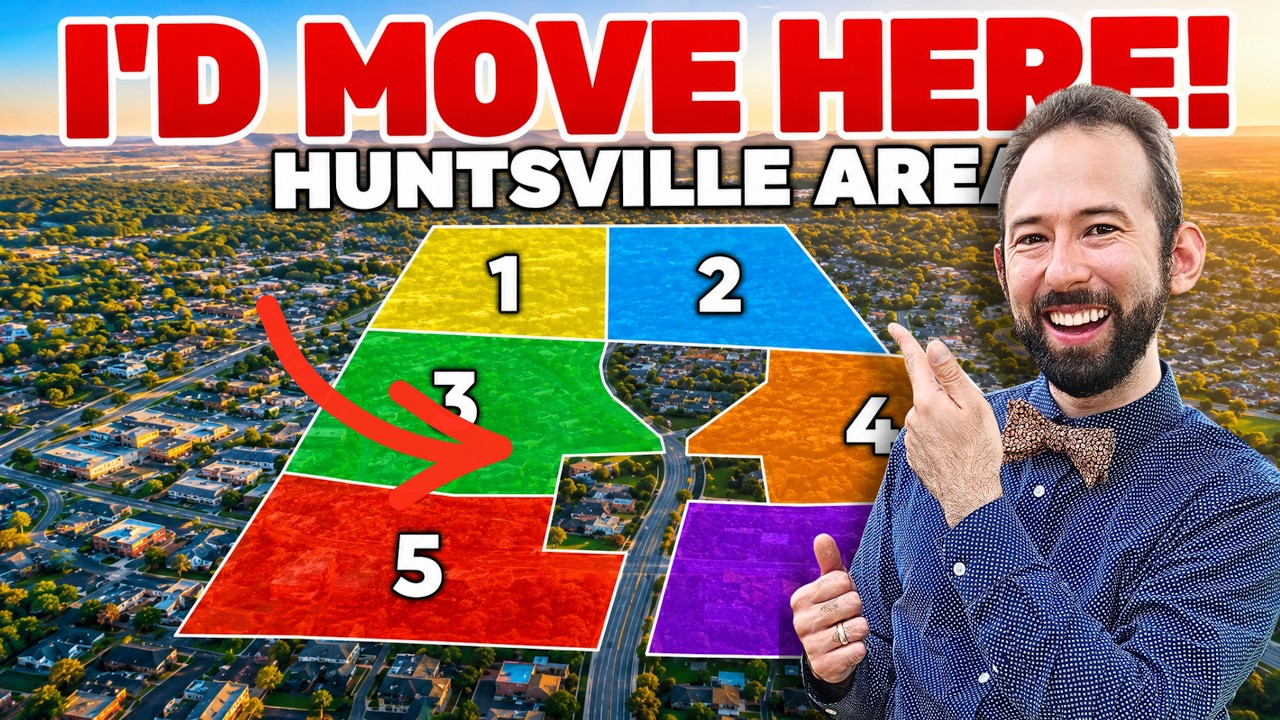
Want a head start? Download the free relocation guide and explore the Explore the Area map to see how the surrounding cities compare.
Thinking about moving to Huntsville, Alabama? Give me a call at 256-384-8486, or schedule a meeting and we’ll go through your budget and what you need in a home. You can also learn more on our relocation page.
Last updated: November 2026
About Richard Graham
Richard Graham is a REALTOR® with Essential Real Estate in Huntsville, Alabama, licensed since 2018 (License# 118332). He grew up in a military family that relocated often, and his family later moved to the Huntsville area. He runs the YouTube channel Living In Huntsville AL and helps relocating buyers find the right home.
About Richard
Phone: 256-384-8486 • Email: Team@living-in-huntsvilleal.com
Essential Real Estate • Equal Housing Opportunity • License# 118332
All information provided is deemed reliable but is not guaranteed and should be independently verified. This website and its affiliates make no representation, warranty or guarantee as to accuracy of any information contained on this website. You should consult your advisors for an independent verification of any properties or legal advice.
Living in Huntsville Alabama - Essential Real Estate
Richard Graham is a dedicated REALTOR® with Redstone Realty Solutions, LLC, serving home buyers and sellers across Huntsville, Madison, Athens, and North Alabama. Licensed since 2018, he combines deep local market expertise with a strong commitment to client advocacy.
Recent Posts